Monitoring of nature infrastructure - Skill acquisition for Nature-based Solutions
NbS Corner - Our Work
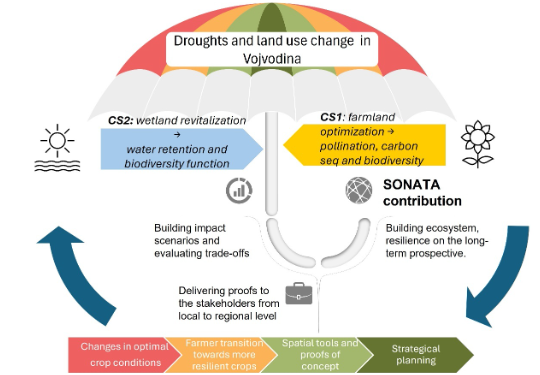
SONATA develops and operationalizes Nature-based Solutions in Vojvodina, a region highly exposed to drought, land degradation, and climate variability. By working directly in vulnerable landscapes, SONATA ensures that NbS planning tools and indicators are scientifically robust, regionally relevant, and ready for real-world decision-making. Through integrated case studies, SONATA translates data and models into practical decision-support tools that help identify where NbS make sense, what benefits they deliver, and what trade-offs they involve.
Soil organic carbon as a decision-relevant NbS indicator
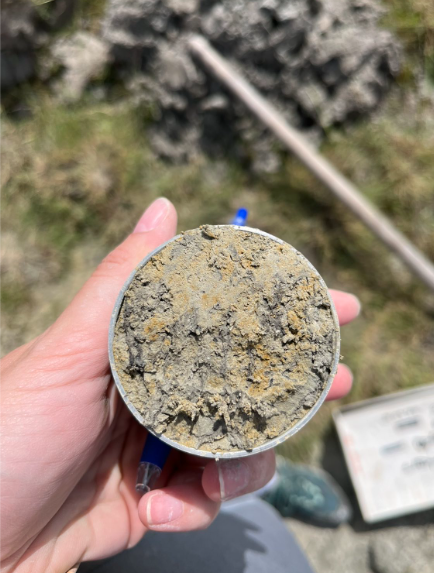
Healthy soils are a cornerstone of effective NbS. SONATA established the firstregionally calibrated soil organic carbon (SOC) reference system for natural and semi-natural ecosystems in Vojvodina. A machine-learning-assisted sampling framework ensured representative, reproducible, and scalable soil monitoring. Soil samples were collected following international standards and analyzed for physical, chemical, and biological properties, including microbial diversity.
New measurements were integrated with historical SoilAtlas data, improving SOC maps and reducing uncertainty compared to global datasets. Results demonstrate the importance of locally calibrated data for NbS planning in heterogeneous landscapes.
Key outcomes include:
A regional SOC reference system for green infrastructure
Improved, decision-ready SOC maps
A transferable soil sampling framework for data-poor regions
Linking NbS to agricultural benefits: pollination and yield
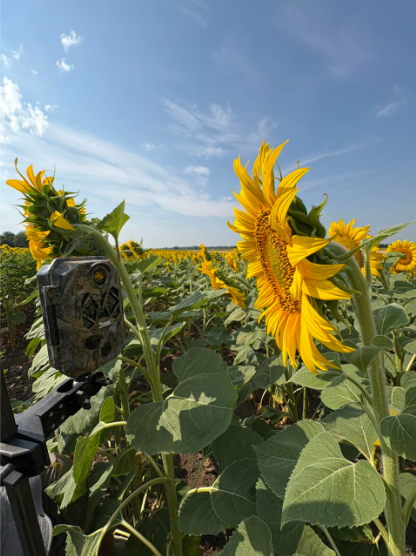
SONATA quantifies NbS benefits for agriculture through a two-year pollination-limitation experiment using sunflower as a model crop. The study assesses how pollinator diversity and crop yields vary across landscapes with different proportions of semi- natural grasslands. Field experiments, wildlife cameras, pollinator surveys, and image-based seed analysis are combined to link habitat configuration with yield outcomes. Early results show increasing pollination limitation with distance from semi-natural habitats, highlighting the role of grasslands in sustaining pollination services. These findings are integrated into crop-pollination models that estimate how NbS adoption enhances yields at the field scale, supporting both ecological and economic decision-making.
Revitalizing habitats for drought resilience
Habitat restoration is a high-impact NbS for improving water retention, biodiversity, and climate resilience. SONATA applies a Before-After-Control-Impact (BACI) framework at a pilot wetland site in northern Vojvodina to assess hydrological, ecological, and socio- economic effects.
Baseline conditions were established using UAV and LiDAR surveys, soil and hydrological measurements, and conceptual water-balance modelling. Monitoring focuses on water dynamics, soil condition, biodiversity recovery, and ecosystem services for local communities.
The case study is embedded in the Water-Energy-Food-Ecosystems (WEFE) Nexus, reflecting the strong interdependencies between water management, agriculture, ecosystems, and regional sustainability.
From pilots to scalable NbS solutions
Across all case studies, SONATA integrates field data, modelling, and stakeholder input into spatial decision-support tools. These tools support transparent NbS planning by linking environmental benefits, land-use change, and economic implications.
By grounding NbS in region-specific data and real landscapes, SONATA supports the uptake of effective, scalable, and context-appropriate solutions across drought-prone regions.
This project is funded by the European Union under Horizon Europe (Project SONATA GA 101159546)